At the Venice Fair
Salieri
Information
At the Venice Fair (La fiera di Venezia, 1772)
Commedia per musica in 3 acts
Music by Antonio Salieri
Libretto by Giovanni Gastone Boccherini
English translation by Gilly French and Jeremy Gray
21, 22 July - The Deanery garden, Bampton
28 August - The Orangery, Westonbirt School
13 September - St John's Smith Square
Cast
Duke Ostrogoto, from Vicenza Andrew Henley
Marchioness Calloandra, his fiancée Sarah Chae
Falsirena, his new amour Ellen Mawhinney
Belfusto, her admirer Aaron Kendall
Grifagno, Falsirena’s father, a trickster Philip Sheffield
Rasoio, innkeeper at the Black Ox Guy Beynon
Cristallina, a lace seller, admired by Rasoio Iúnó Connolly
Conductor: Thomas Blunt
Director: Jeremy Gray
Synopsis
The opera is set at the Venetian Ascension-tide fair, the Festa della Sensa. Like many 18th century comic operas, the story concerns the amorous entanglements of three couples of different social status, and in particular Duke Ostrogoto, his fiancée the Marchioness Calloandra, and his flirtatious and resourceful new friend, Falsirena.
Act 1
The opera opens in a Venetian piazza where market traders are peddling various wares. Duke Ostrogoto, a tourist from Vicenza, is busy impressing Falsirena, much to the annoyance of her former love, Belfusto.
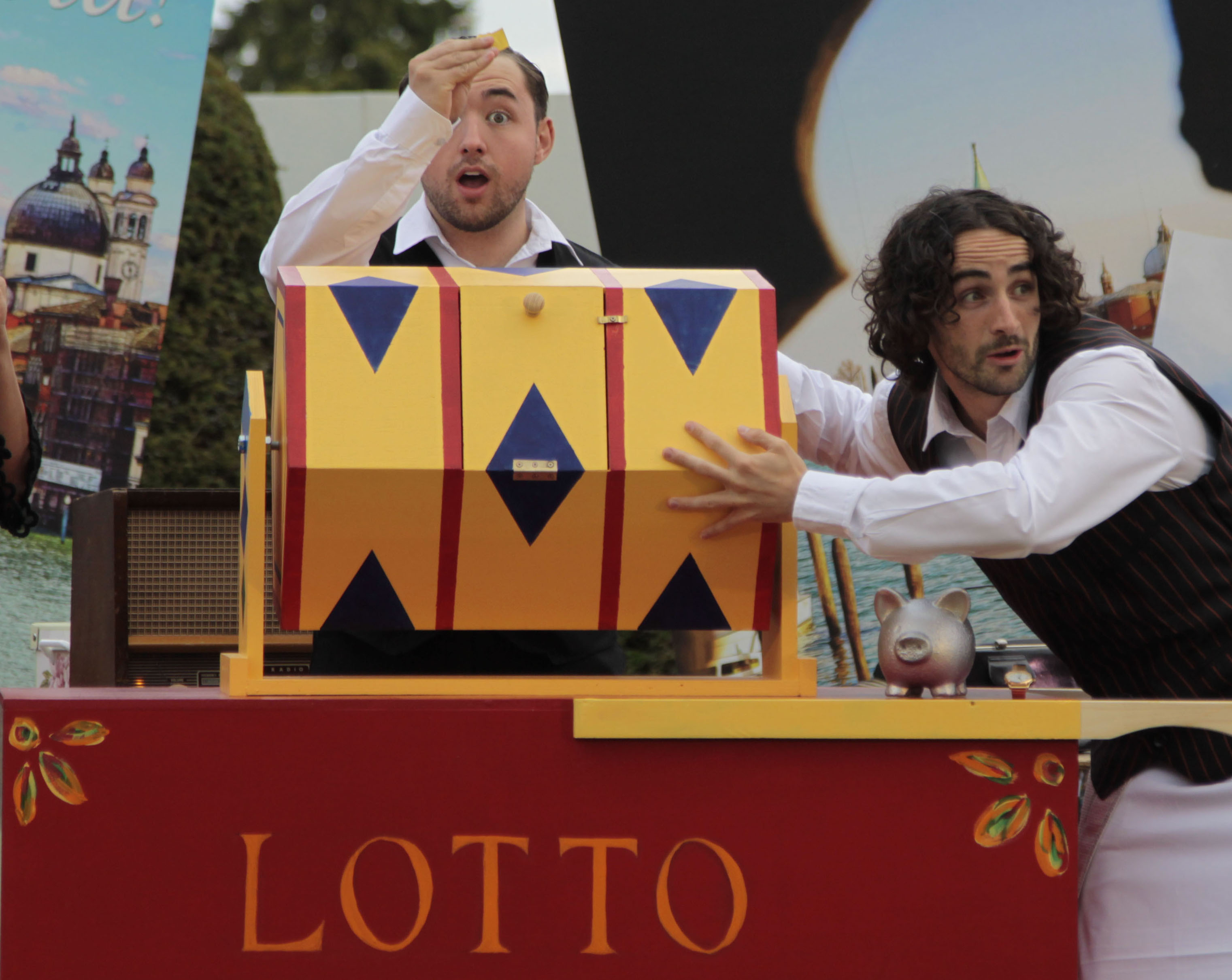
The Duke’s plans for an affair with Falsirena are thrown into disarray by the arrival at the same inn of his fiancée, Calloandra. Ostrogoto needs to keep the two women apart. The aristocratic couple are visited by Cristallina bringing an embarrassing parcel of lingerie intended for Falsirena. Next Falsirena herself arrives, but claiming to be an out-of-work Italian singer: as ‘Alamirena’, she hopes to auction her watch. Calloandra wants to hear how well she can sing – they share a duet from Acis and Galatea, and Alamirena continues with an improvised comic operatic scene. A lottery is set up to raffle the watch, but Falsirena’s disreputable father Grifagno is prepared to cheat. The tickets are fiddled, he wins the jackpot, and the scene ends in mayhem.
Act 2
Falsirena continues to plague Ostrogoto, hoping to prise him from his fiancée: she next appears disguised as a French cosmetics merchant. Adding to his confusion, Ostrogoto is visited by a German baroness, another of Falsirena’s enterprising multi-lingual disguises.
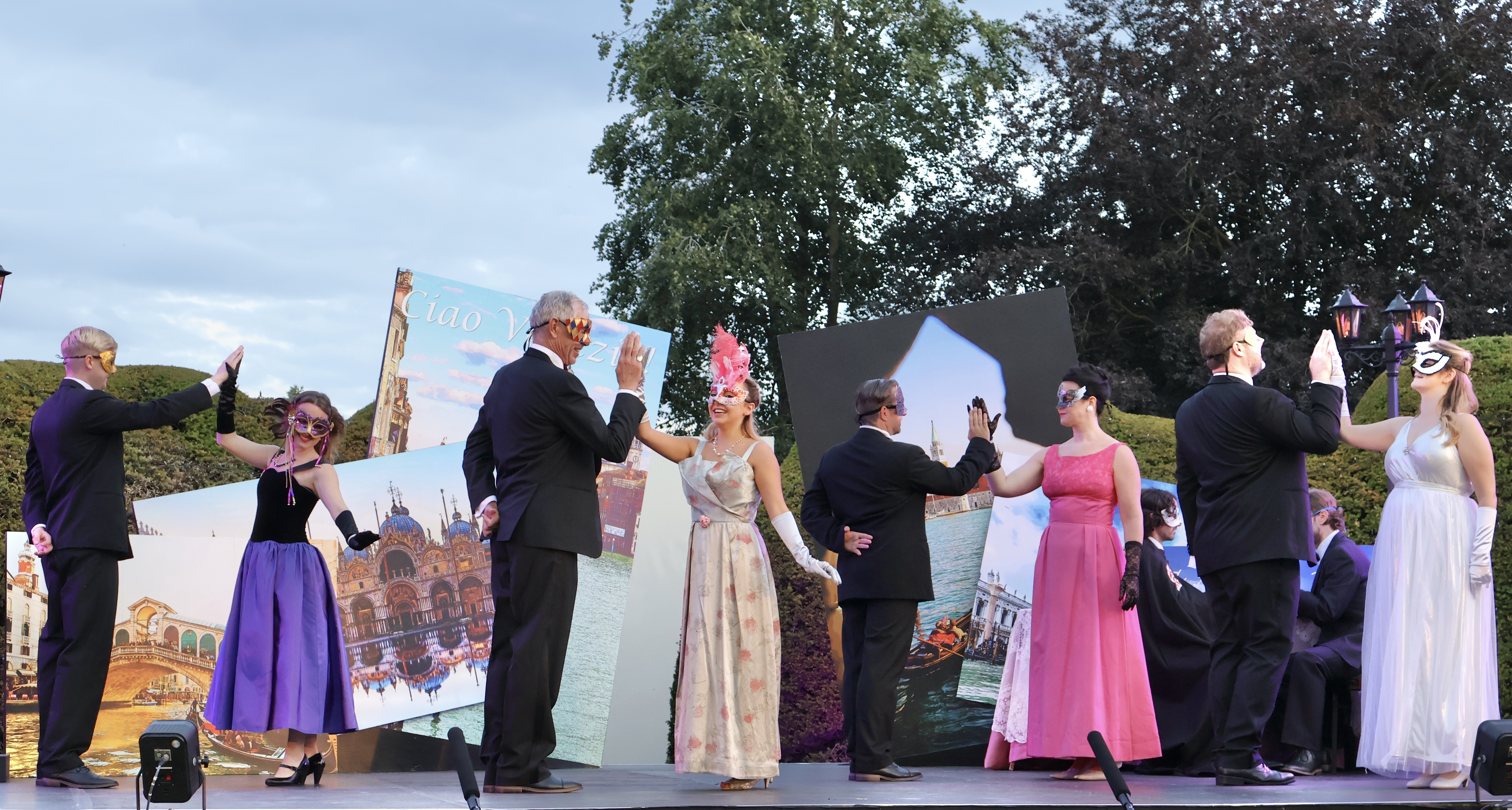
Cristallina fails to extract payment from Grifagno for the order she supplied for Falsirena’s lingerie. As revenge, Cristallina explains to Calloandra exactly what is going on, and the latter is furious about her errant fiancé. Everyone meets at the masked ball which celebrates the Festa, a prime venue for intrigues and affairs. Falsirena patches things up with Belfusto and together they plan to use disguise as gondoliers to confuse the Duke. Calloandra also tricks the Duke by wearing the same dress and mask as Falsirena. When Calloandra reveals her true identity, Ostrogoto is horrified: Calloandra faints and again the act ends in total confusion.
Act 3
We learn that Calloandra has broken off her engagement. Ostrogoto discovers that Belfusto is not Falsirena’s cousin, as he believed. Rasoio proposes to Cristallina, who is thrilled. Ostrogoto wants to punish all the Venetian swindlers and has Belfusto and Grifagno arrested, although they are innocent of any real crime. Calloandra offers to take back Ostrogoto and declares her love. Ostrogoto confronts Falsirena over her affair with Belfusto, but she refuses to beg for forgiveness. Cured of his obsession with the girl, he promises her Belfusto, and releases the prisoners.
By the time of the short final scene, the Duke and Marchioness have married, and arrive by gondola at the San Marco quayside. Calloandra forgives Falsirena. Everyone toasts the three happy couples – Rasoio and Cristallina, Belfusto and Falsirena, and Ostrogoto and Calloandra.
Bampton Classical Opera's brilliant young cast
Opera Today September 2023
Opera-in-the-garden can be rather a hit-and-miss affair, given the vagaries of an English summer. One night the sky is blue, the sun is benevolently warm, the breeze brushes gently and all is beatific. The next, clouds lower, the wind howls, the rain buffets and one needs to beat a retreat.
Such was the case back in July when the first night of Bampton Classical Opera’s 2023 UK premiere production of Salieri’s La fiera di Venezia (At the Venice Fair) basked in summer balm, and the next evening, which I attended, saw cast and audience huddled inside St Mary’s Church, to escape the sudden onslaught of winter.
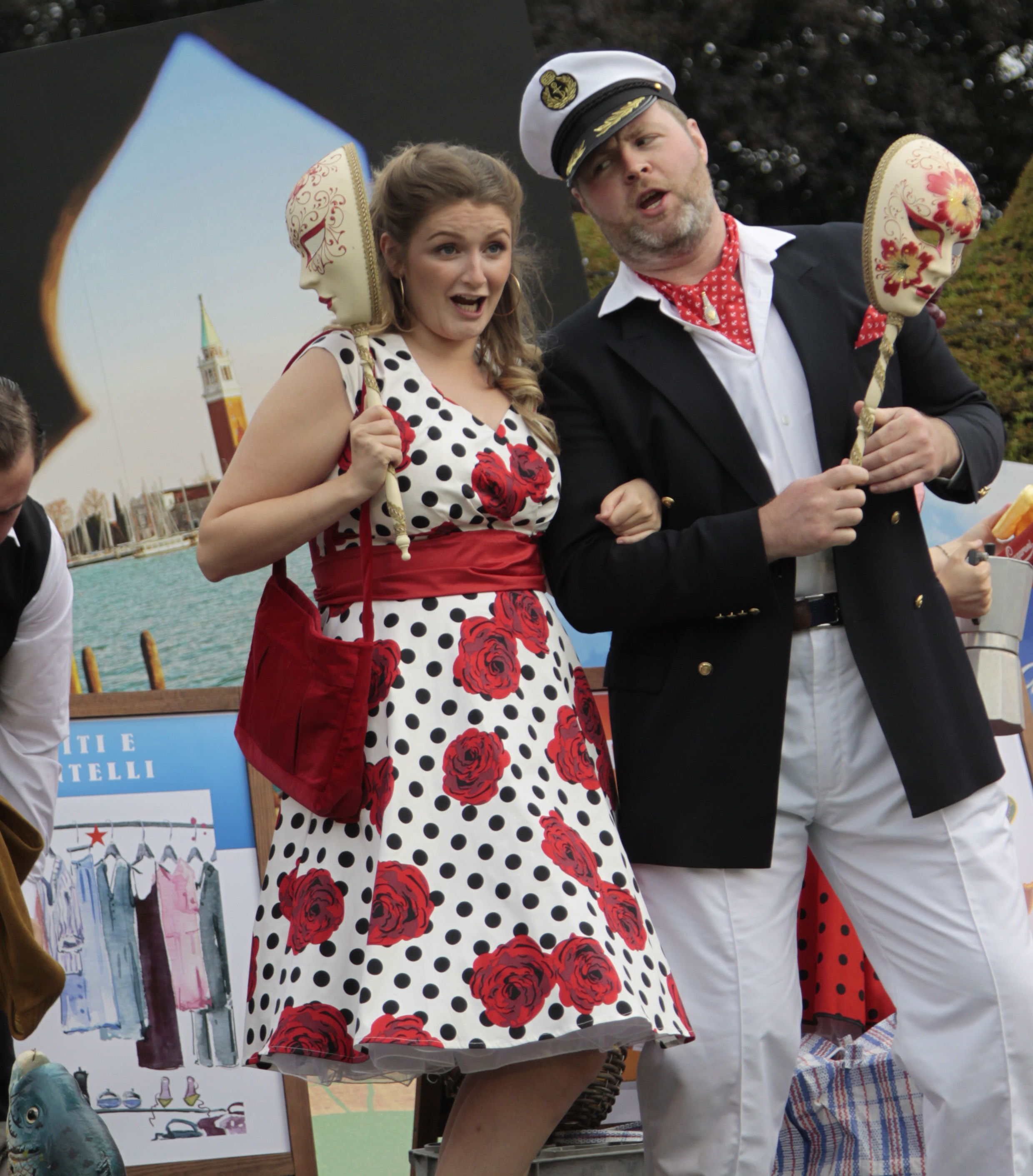
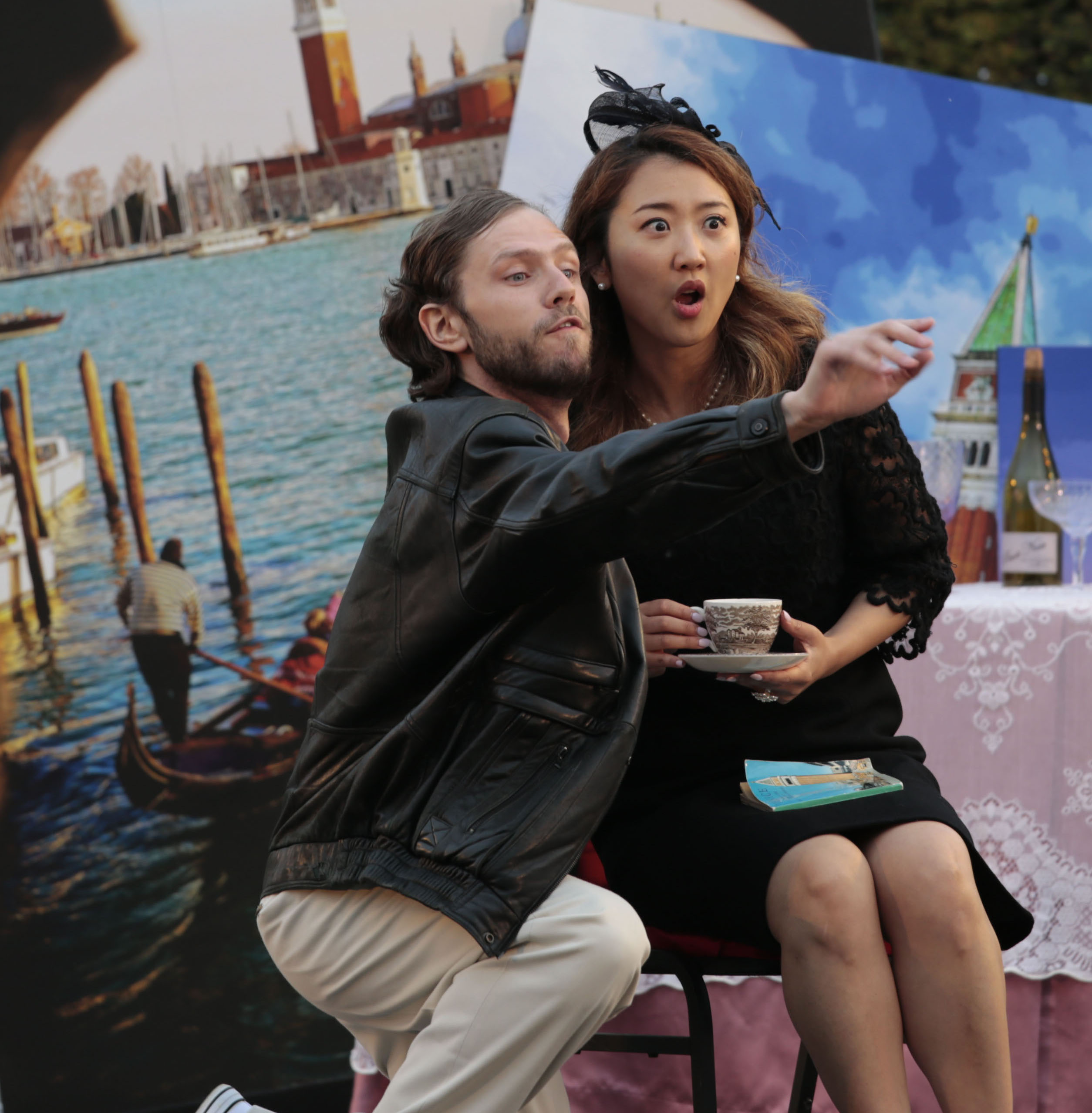
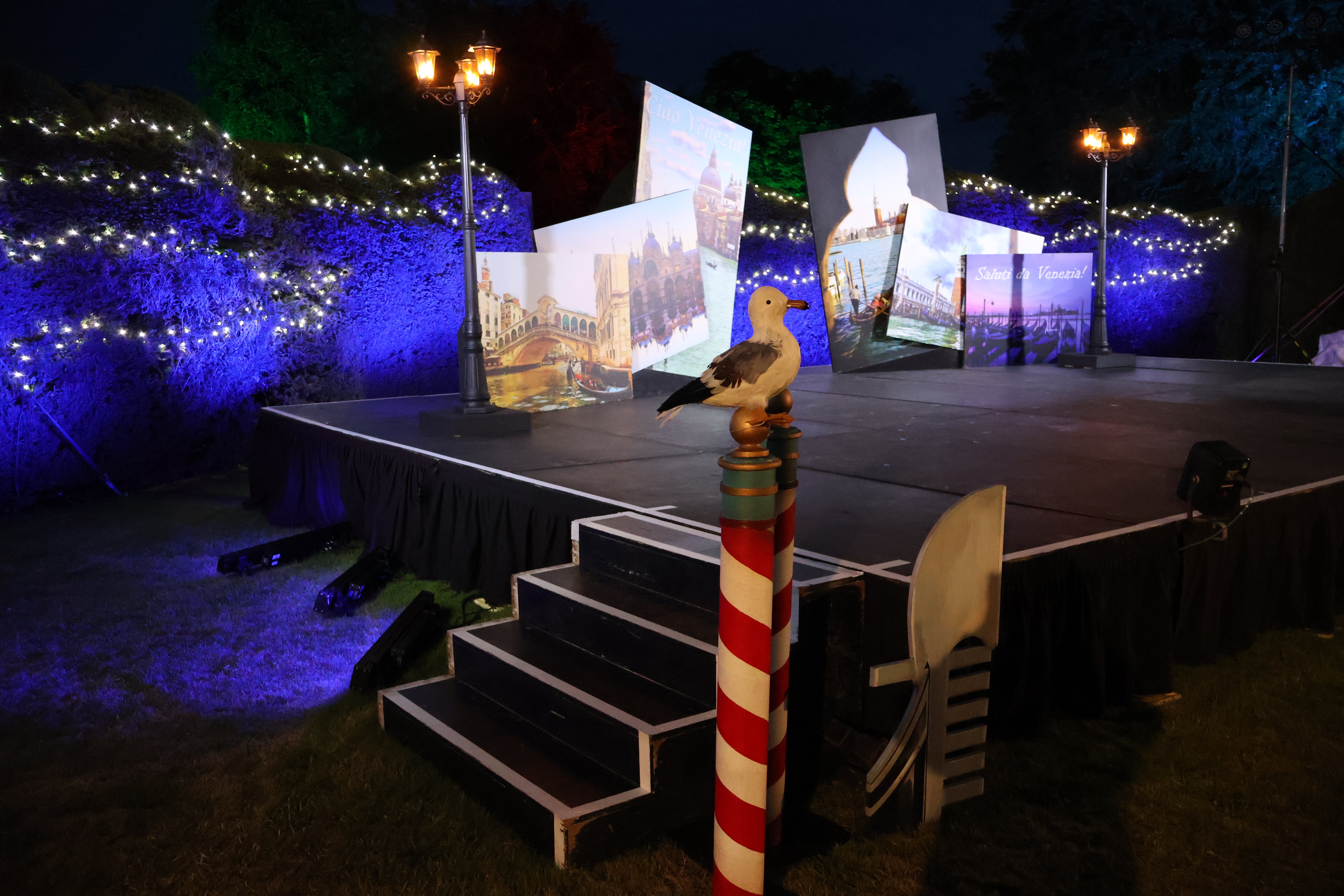
It was, of course, of no matter. Bampton Classical Opera’s brilliant young cast exploited the energetic charm of Salieri’s well-paced score and overcame the challenges of the reduced space with admirable adaptability. It was a pity, though, that the small dimensions of the church meant that we lost much of director-designer Jeremy Gray’s pretty set, though some choice props – gondoliers’ striped poles, traders’ advertisements, and a pulpit-perched seagull – along with Ian Chandler’s warm lighting, and costumes which contrasted glitzy glamour with polka-dot playfulness, all served to conjure the sights and delights of Venice.
It was very pleasing, therefore, to be able to see the production unfold from those damp-July confines when the production travelled to St John’s Smith Square. A montage of picture-postcard charm backed the performance space, offering glimpses of La Serenissima – both heritage chic and tourist tat. The columns of St John’s Smith Square provided an apt touch of spiritual grandeur and secular self-importance. As the nippy overture tripped along, the petty Venetian merchants had room to spread out their wares and use their wiles to win over the punters. The latter included the audience as the weasel-like Grifagno wended his way through the SJSS ranks, tempting, touting and tricking.
Antonio Salieri was 21 years old when his three-act commedia per musica, La fiera di Venezia, premiered at the Vienna Burgtheater in 1772. It proved as successful as the composer’s Armide had been the previous year. In the following decades it was taken all over Europe – Haydn staged and conducted it at the Esterhazy court theatre in 1782 – though not, it seems, to Venice itself. Nor to England.
The ‘Fair’ of the title is not, as one might expect, the Carnival – though there’s a carnivalesque wildness about much of the opera’s action – but rather the Festa della sensa, or Ascension Day Festival: a civic and religious holiday during which the Doge was symbolically wedded to the sea. It provides the context for bringing together three couples of contrasting social rank: the aristocratic Duke Ostrogoto and his fiancée, the marchioness Calloandra; the bourgeois Falsirena (the Duke’s new amour) and her jealous suitor Belfusto; and the keeper of the Black Ox inn, Rasoio, and lace seller Cristallina – with amorous muddles and mayhem ensuing.
The festival also presents an excuse for animated ensemble scenes, and it was a joy to see these busy, bustling scenes – laced, by turn, with impish glee and intrigue – open out: the neat choreography of the piazza market generated a palpable buzz; the raffle with which Act 1 concludes had a theatrical pulse and wit; the celebratory masked ball, with its stately minuets and elaborate interplay and exchanges – brilliantly choreographed by movement director Karen Halliday – seemed to anticipate the first-act finale in Don Giovanni, and thus reminded one of the Goldonian commedia traditions within which Mozart was working. The neatness of the interlockings and interweavings, characterfully lit by Chandler, was a delight.
In Act 1, the cast initially seemed a little too aware of the spaciousness of the venue, with its tricky sightlines and difficult acoustic – though one certainly couldn’t complain about their exemplary collective effort to make the text crisp and clear. But, if there was a bit of over-singing and over-egging at the start, things settled down from Act 2, and relaxed theatricality and vocal panache, particularly from the ladies, was the name of the day. Once settled into the groove, they revelled in both the grace and agility of Salieri’s vocal writing.
Falsirena – clever, resourceful, and with a penchant for disguise – is determined to have fun, and her own way, leading on the hapless Ostrogoto all the while her affections are really for Belfusto. The soprano Ellen Mawhinney sailed breezily through Salieri’s short phrases and rapid vocal lines, quick to take advantage of every nuance, and to add many of her own. This middle-class minx had attitude aplenty, and a full arsenal of eyebrow-jiggling gestures up her sleeve.
Posing as a down-on-her-luck opera singer seeking to raffle her watch, Mawhinney switched deftly from ‘leaden’ seria parody to stylishly light buffo, topping her aria with a raging conclusion of jealous frenzy. Whether impersonating a French soap-seller, a sea-sick German baroness, or disrupting the masked ball disguised as a gondolier – and switching languages with aplomb – Mawhinney spanned the gamut from coquettish to crude, charming to infuriating. Unwaveringly unsentimental, sometimes cynical, this Falsirena clearly delighted in ‘playing the game’.
The soprano Sarah Chae beautifully conveyed the tragic sentiment of Calloandra’s ornate entrance aria, bringing welcome poise to the proceedings. But, she showed that Colloandra could stir things up too. ‘Troppo l’offesa è grande’ was a classic seria rage aria of fire and fury, and Chae’s coloratura showpiece in Act 3, ‘Vi sono sposa’, a model of vocal control and diamanté dazzle, complemented by expressive flute and oboe obligatos – a striking moment of seria intensity amid the prevailing frothiness. Chae has considerable vocal stature and her confident, crystalline negotiation of Salieri’s curlicues impressed.
As the two-timing Duke, the tenor Andrew Henley sang with refinement, addressing Falsirena with lyrical elegance in ‘Il pargoletto amabile’, though Ostrogoto’s presentation of himself as a ‘victim’ of Love did not fool us, or Falsirena. And, Henley was gently self-mocking in the simile aria in which the Duke compares Falsirena’s smile to a clear sky after a storm, and himself to a helmsman who forgets the tempest when he sees his reflection in the tranquil sea. The Duke’s Act 3 duet with the flirty Falsirena, ‘Scordati o Donna ingrata’, was a winningly wry parody of the conventional final act lovers’ duet.
Complaining of the general untrustworthiness of women, Aaron Kendall’s Belfusto had a touch of Masetto’s masculine pride and temper. His diction was excellent, especially in the ‘catalogue aria’ in which Belfusto sprints through a list of the diverse international wares on sale at the fair. As Grifagno, Falsirena’s foolishness father, Philip Sheffield blustered self-interestedly, ridiculed by the market-traders, riled for his rigging of the raffle, and finally arrested along with Belfusto by the aggrieved, duped Duke.
Singing with lovely directness, the tenor Guy Beynon and the soprano Iúnó Connolly captured the fresh style of Rasoio and Cristallina, which contrasts with the aristocrats’ high-flown seria rhetoric. Connolly’s happy acceptance of Rasoio’s marriage proposal rose sweetly above the deceptions and disorder, and her vibrant tone and characterful projection was to be admired throughout.
Conductor Thomas Blunt displayed an impressive command of pace and detail. This was wonderfully deft playing – nifty, nuanced and dramatically expressive – from the musicians of CHROMA, and intonation-secure and stylistically spot-on.
Leopold Mozart was disparaging of Salieri’s opera, condemning its ‘commonplace’ musical ideas as ‘antiquated, forced, and rather lacking in harmony’. But, his son paid it the honour of writing a set of six keyboard variations on the ball scene minuet. Perhaps, too, we might hear in Calloandra’s wistful first aria a hint of the Countess’s soulfulness in ‘Porgi amor’; in Falsirena’s soubrettish ingenuity a blueprint for the feminine feistiness of Susanna or Despina.
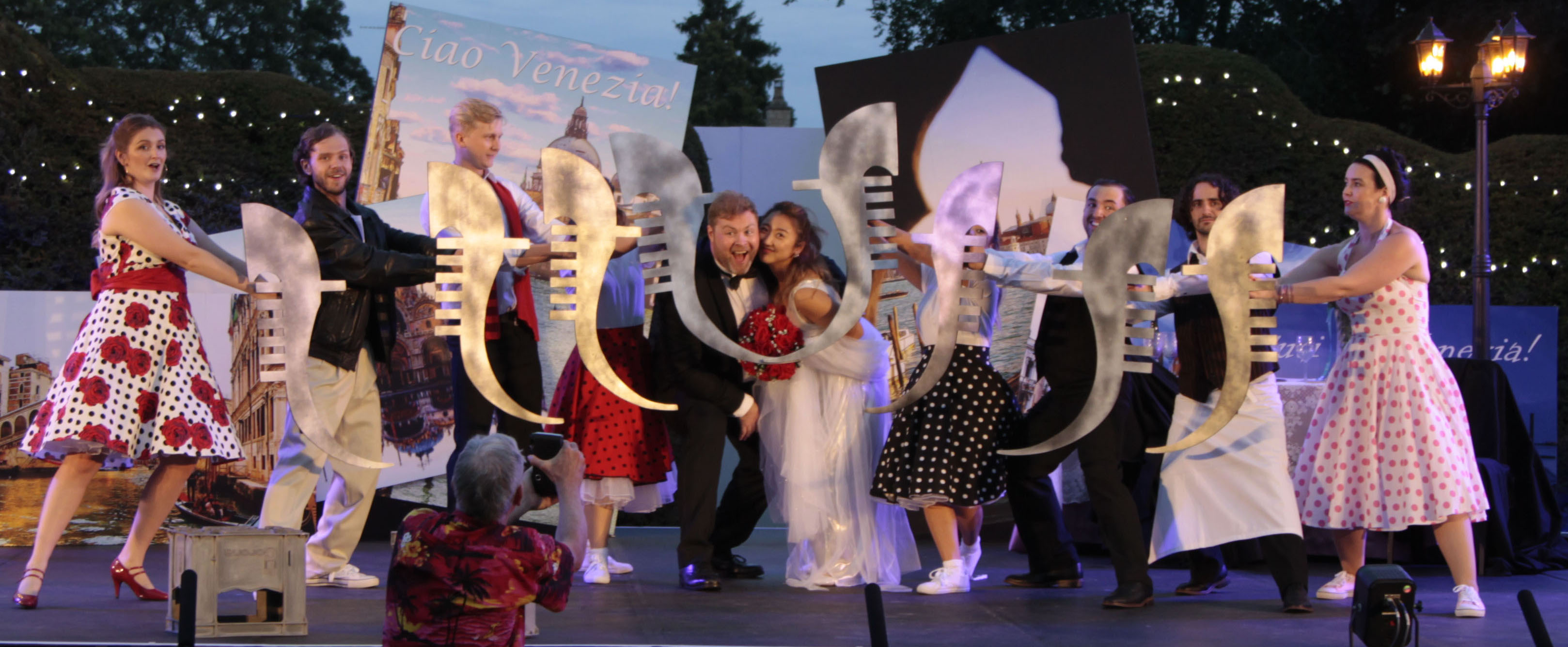
Bampton Classical Opera’s UK premiere productions of La scuola de’ gelosi (in 2017) and La grotta di Trofonio (in 2015) were highly acclaimed. With this lovely staging of At the Venice Fair – which closed with the perfect photo-shoot – Bampton Classical Opera once again confirmed both Salieri’s status as a skilful composer of sprightly music which brings comic situations to life most satisfyingly, and the company’s own musico-comic nous and neatness.
remarkably effective staging... dynamic from the start... *****
Music OMH 13 September 2023
Although Peter Shaffer’s play Amadeus, and subsequent film directed by Miloš Forman, helped to raise the profile of Antonio Salieri, overall they were mixed blessings for the composer. Despite Shaffer always being clear that he was presenting a virtual fiction, the popular perception of Salieri as a mediocre talent remains, and there are simply not enough performances of his works to overturn it. One can hope that, with 2025 marking the bicentenary of his death, many companies will present his compositions and allow for this image to be revised, but there is no guarantee that they will. With all festivals having to be risk averse in the wake of the pandemic, meaning they have less scope to programme rarities whose selling power is unproven, it is uncertain that we will see many of his operas. Even if there are to be an abundance, it should not be forgotten that one company has been presenting his works in the UK far more than any other over the past 20 years. This is Bampton Classical Opera, which specialises in bringing little known 18th century works to public attention, and which performed Falstaff(1799) in 2003, La grotto di Trofonio (1785) in 2015 and La scuola de’gelosi (1778) in 2017.
Bampton is currently celebrating its 30th season with Haydn’s Lo speziale (1768) and Salieri’s La fiera di Venezia (1772). When it first presented the latter, performing it in English as At the Venice Fair, in Oxfordshire in July, it constituted the UK premiere of the opera, because, while many works by the composer did make it across the English Channel in the 18th century, this was not one of them. The performance at St John’s, Smith Square constituted the last of three, following appearances in Bampton and Westonbirt, and highlighted both the quality of the opera and the company’s own dynamic approach to presenting such works.
Salieri wrote the three act opera buffa, which he described as a commedia per musica, at the age of 21. The original Italian libretto was by Giovanni Gastone Boccherini, brother of the composer Luigi, and, following a successful premiere at Vienna’s Burgtheater in 1772, it went on to enjoy around 30 productions across Europe during his lifetime. Set in Venice during its Festa della Sensa, it considers three couples who all come from different social strata, and the confusion that reigns as various attempts at two timing see the classes become mixed up. Duke Ostrogoto from Vicenza is engaged to the Marchioness Calloandra, but is also having an affair with one Falsirena. The latter is, in turn, stringing Ostrogoto along because she is in love with Belfusto, who she pretends is her cousin whenever the Duke is present. There are also the working class characters of Cristallina, a lace seller, and Rasoio, the innkeeper of the Black Ox, while the one character who is not part of any couple is Falsirena’s father, the charlatan Grifagno. The opera has a happy ending when the couples from the ‘correct’ social class, and hence order, are restored.
The high quality score supports the entertaining subject matter well, with the Overture conjuring up an image of a busy Venetian piazza full of merchants peddling their wares. The close of Act II features a masked ball, the music of which Mozart may well have pocketed in his mind, and used 15 years later as inspiration for the party that ends Act I of Don Giovanni. This is why our knowledge of Mozart’s operas remains incomplete if we do not know Salieri’s as well. Without awareness of them we are restricted to seeing how Mozart developed his own writing from one opera to the next, without understanding the influence of others upon it. Certainly, Mozart wrote a miniature set of keyboard variations on the minuet ‘Mio caro Adone’ that appears in this ball scene, which Amadeus acknowledges, but distorts the fact that it shows just how highly he regarded Salieri’s music.
The masked ball also has a touch of Act IV of Le nozze di Figaro about it as it involves a character dressing up to look like another. The Marchioness also restores her relationship with the Duke in a way that does not feel dissimilar to the Countess forgiving her husband in Figaro. Rasoio sings an aria in which he tries to warn the Duke that a supposed German Baroness is actually Falsirena, but, because the Marchioness keeps moving into earshot every time he is about to say her name, he is always forced to utter things like ‘fa-so-la-ti-do’ instead. This does not feel dissimilar to the Finale to Act I of Gilbert and Sullivan’s The Mikado when Katisha proclaims a series of words that rhyme with ‘Mikado’, but every time she tries to say the name itself she is drowned out by the chorus.
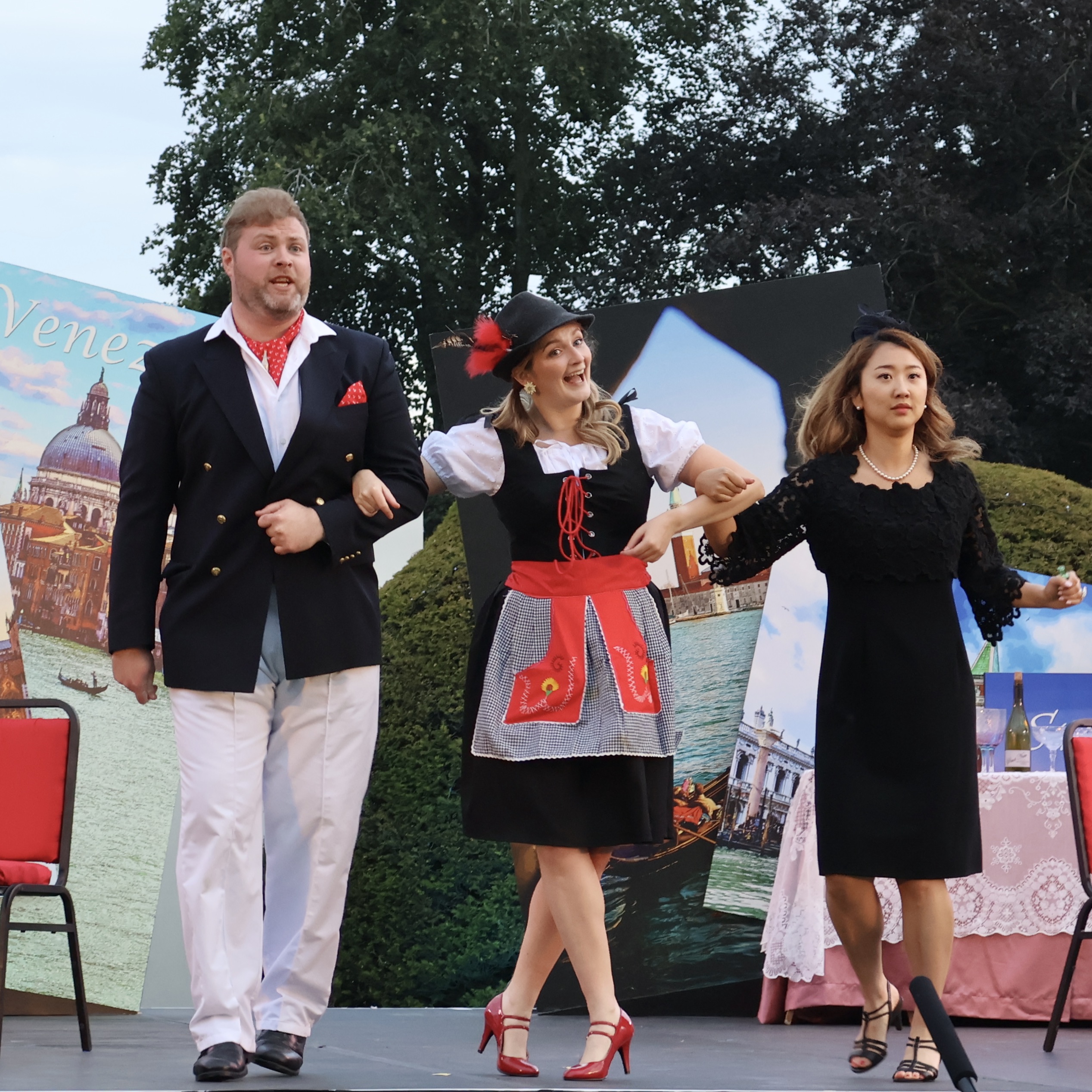
Although the production was lo-tech, which is unsurprising as it had to be presented in three disparate locations, it is remarkable just how effective Jeremy Gray’s staging was. With the set presenting a series of painted and postcard images of Venice, along with mooring poles and the bows of gondolas, a strong impression of the hustle and bustle of the city was instantly generated. The audience entered to see signs reading ‘mercato chiuso’, but as soon as the Overture began the various stall holders turned these around and in next to no time the fair felt in full flow. The production was thus dynamic from the start, and at no point did the energy ever really drop. The dancing, courtesy of Karen Halliday, was carried off well by the seven soloists and four chorus members, and there was a fair amount of it at the masked ball, probably because the librettist Boccherini was primarily a choreographer and dancer.
Gray and Gilly French’s English translation was excellent, with lines including the brilliantly slick ‘What a daughter. She’s defending him as truly as she oughta’. It included topical references so that the Venice fair was described as receiving ‘Downton tourists’, because the village of Bampton sees many as it was a filming location for the series. There was always something in which to take an interest as lines contained references from different periods of time. For example, when they were prisoners, Belfusto and Grifagno sang the 1940s phrase, ‘There are good times just around the corner’, which Noel Coward subsequently parodied in a song by substituting the word ‘good’ for ‘bad’.
Thomas Blunt’s conducting of the CHROMA ensemble was superb, while there were a host of outstanding performances from the cast, which included Aaron Kendall as Belfusto, Philip Sheffield as Grifagno, Guy Beynon as Rasoio and Iúnó Connolly as Cristallina. Andrew Henley was a particularly fine Duke Ostrogoto, as he asserted his strong tenor to splendid effect. Sarah Chae as the Marchioness revealed an extremely warm and nuanced voice, while Ellen Mawhinney combined a compelling soprano with the right sense of mischievousness, so that it felt like a natural extension of Falsirena’s character for her to assume various disguises. Following such a memorable evening, the only question that remains is which Salieri opera will Bampton decide to present for his big year in 2025?
another hidden gem... one which is here to stay
Seen and Heard International 23rd July 2023
Blessed with warm sunshine, the gardens at the Deanery in Bampton are the ultimate summer opera venue. A super setting deserved a super performance of the Salieri UK premiere, At the Venice Fair, a delightful 1772 opera buffa experience with big choral scenes, a rollicking libretto with clever English translation by Gilly French, plenty of dances, eighteen arias giving rise to lots of comedy moments. Looking down on this huge success would be a delighted Bampton donor, none other than Joyce Grenfell, via the Memorial Trust in her name. She would have adored the way the simplicity of the work, its clarity, its naturalness wove their way through the drama delivering some of the most amusing moments heard at this year’s summer operas. Director Jeremy Gray’s programme notes make a special reference to how well Salieri understood the seriousness of light entertainment. Grenfell would fully approve of that! Others have admired the work, not least the Monty Python Flying Circus production team when they used the exciting opening bars as signature music for a 1974 episode.
Prone to frequent tampering with his scores, Salieri was not unknown to repeat bars unnecessarily! Thanks to the tenacity and diligence of French and Gray, the manuscript, with all those repeated bars, was discovered in Dresden and brought back to life for UK opera-loving audiences – a ‘new to UK’ opera which many will now wish to produce, enjoy and marvel at the composer’s skill in constructing those eighteen arias with three particularly delightful coloratura ones which Sarah Chae (Marchioness Calloandra) took every opportunity to exploit to the full. At the Venice Fair became one of Salieri’s best regarded works during his lifetime being staged many times across Europe. In admiration of the composer’s skill, Mozart composed a set of variations for piano (K.180) on a theme from this opera – a friendly gesture from the younger composer to the elder.
Conductor Thomas Blunt’s longstanding links with Bampton gives huge confidence to all on stage. He is a master of pace, knowing exactly when to choose the longer pause and when to lift the tempo. Small the band may be, just fifteen, but the sound is exquisite. Elegant flute (Emme Bains) and oboe playing (David Benfield) provided excellent support to the delightful arias in Act III, by which time the trickery and deception which develops at pace in Act II has been exposed.
Act I, set in a Venetian piazza, a market square full of varied merchandise on stalls is the chance for Duke Ostrogoto (Andrew Henley) to escape the clutches of his fiancée, the Marchioness. In so doing he takes time to engage with his new love, Falsirena (Ellen Mawhinney). She is an instant success with the audience, she radiates charm and guile at the same time; her voice is strong and she enjoys being the centre of attention on stage. What potential she has! Now in her first year at Royal Academy Opera she is one student to watch for a big future. No matter what her disguise – out of work opera singer, lover, or peasant girl – she demands special attention.
South Korean born Chae, the long-suffering fiancée Marchioness Calloandra, has a challenging time trying to prevent her beloved straying too far. This Chae achieves when, ultimately, she confronts Henley’s Duke with the truth about his behaviour, singing the aria, I am your bride and lover, one of the evening’s top highlights and a truly memorable moment. Henley is a confident performer; Chae and Mawhinney are the stars; lúnó Connolly, the lace seller and her four stall-holder colleagues, Harriet Cameron, Tilley Goodwin, Osian Clarke and Owain Rowlands, all make the most pleasing of contributions in the marketplace and at the ball which ends the second act. Wearing identical ball gowns, the Marchioness and Falsirena successfully expose the unfaithfulness of their lover. (Pauline Smith and Anne Baldwin deserve special mention for the creation of those beautiful, often stunning costumes.) Act III sees the happy ending with the Marchioness finally marrying the Duke, and Falsirena, securing her release from the clutches of the Duke, receiving the Marchioness’s forgiveness, and marrying the persistent Belfusto (Aaron Kendall). Meanwhile Rasoio (Guy Benyon) the scheming innkeeper at the Black Ox tavern marries the delightful lace seller, Cristallina who sings with such happiness, With what delight I’m leaping with joy.
The introduction of several ornamented stems of gondolas helps build At the Venice Fair to a fabulous finale with lights on the bushes and in the wings depicting the gas lights of a Venice quayside. Bampton Classical Opera has discovered yet another hidden gem not previously heard in the UK; one which is here to stay.
engaging, animated... captures the good spirits of a lively opera
Classical Source 21st July 2023
Salieri’s sixth opera, La fiera di Venezia (1772) is set during Venice’s famous Ascension Day ceremony (the Festa della Sensa) rather than at carnival time earlier in the year and is rendered here as At the Venice Fair in Gilly French and Jeremy Gray’s translation, updating some of its references and idioms. The librettist, incidentally, was the brother of Luigi Boccherini, the far more famous composer and cellist. As with so much eighteenth-century operatic repertoire, including most of Salieri’s own sizeable output, the opera has remained virtually forgotten, even though it was one of the composer’s more widespread successes in his lifetime. And a distant echo of its fame remained in the fact that Mozart composed some keyboard variations on the melody of ‘Mio caro adone’ (K180) which appears in the midst of the extended sectional or ‘chain’ finale to Act Two.
Gray’s production sets the action against a backdrop of colourful, eye-grabbing, touristic photographs of Venice in contemporary times, astutely tying in with the fact that the opera’s original scenario itself conjures up a city as popular with visitors in the eighteenth-century as now, with much substandard accommodation (Rasoio presides over a less than ideal inn) and traders peddling all sorts of gewgaw wares and trinkets (Cristallina offers lacework and lingerie to Falsirena, and the latter amusingly takes an item of underwear to be a mantilla). Although many of the work’s themes are common to just about every opera buffa of the time, it is nevertheless striking how the central plot foreshadows Mozart’s two outstandingly ingenious comedies of a decade and a half later, The Marriage of Figaro and to some extent Don Giovanni, which would both significantly develop and subvert the genre. At the centre is a philandering aristocrat, Duke Ostrogoto – broadly and blusteringly projected by Andrew Henley with an apt degree of slyness – who takes a fancy to his social inferior, Falsirena, despite being already engaged to the Marchioness Calloandra, in Venice herself for the fair.
Much of the comedy arises from the ruses to corner and shame him, and his attempts to keep the two women apart. It doesn’t have the biting social and political satire of Figaro and resolves with a conventional happy ending as the three couples are paired off correctly and can get married as planned. There is nothing of Don Giovanni’s punitive conclusion therefore, though the masked ball scene of Act Two’s finale prefigures the similar episode in Mozart’s opera with its mixture of dances in the music. Calloandra’s ultimately forbearing and merciful attitude draws a close comparison with Countess Almaviva, underlined by Sarah Chae’s impressively agile singing and finely delineated melodic lines, even if her diction isn’t always quite clear. The dignified rendition of her first aria puts one in mind of ‘Porgi amor’, as the programme note rightly suggests; and the coloratura sparkle of her concluding number displays the Marchioness’s magnanimous nature, like the Countess, in forgiving the Duke, although the additional colour of concertante flute and oboe anticipates the similar scoring and style of Konstanze’s gutsy ‘Marten aller Marten’ in The Abduction from the Seraglio.
Ellen Mawhinney is a persuasive Falsirena, using vibrato efficiently to bring allure and charm to her music as she strings along both the Duke and her existing boyfriend, Belfusto, but also navigates with winning virtuosity her disguises as an opera singer, a French cosmetics salesperson, and a German noblewoman. Aaron Kendall whimpers and laments mellifluously as that unfortunate lover, while Philip Sheffield projects a certain brazen guile as her skinflint father, Grifagno. Guy Beynon evinces a delicately light, winsome tone as the innkeeper, being eventually matched up with Iúnó Connolly’s saucy Cristallina.
The small forces of the Bampton Classical Opera orchestra keep up an engaging, animated account of the music, which suits the prevailing cheerfulness of the drama. Woodwind and horns add an intermittent warmth to the strings’ dependable gloss. Although Salieri probably didn’t know any of the compositions by the natively Venetian Vivaldi, in this performance the buzzing semiquavers which accompany the lottery scene at the end of Act One rather evokes the fizzing energy of the sinfonias or concertos for strings without soloist by that composer. Overall, the production captures the good spirits of a lively opera.
abounds with vigour and charm
The Stage 24th July 2023
Who doesn’t love opera outdoors? Fresh air, a picnic enjoyed in verdant surroundings and, best of all, a sense that you are right there on stage with the performers. Yet such summery bliss can be quickly shattered by unexpected sounds, such as incessantly cooing doves or chattering audience members, or the weather – perhaps a sudden cloudburst that sends performers and audience seeking shelter? Now in its 30th year, Bampton Classical Opera has evidently decided that opera al fresco is a risky, but worthwhile endeavour.
On the opening night of Jeremy Gray’s production, in Bampton’s Deanery Garden, the weather was accommodating and there was no need for a swift retreat to the church. Gray’s staging, with an energetic, youthful cast, abounds with the vigour and charm we have come to expect from this company.
As part of its mission to revive lesser-known Classical-era operas, Bampton has long championed Antonio Salieri (1750-1825), a composer known, probably wrongly, as the jealous composer who drove Mozart to his early death. Salieri was just 21 when this work (La Fiera di Venezia) debuted at Vienna’s Burgtheater in 1772. It was an immediate success and performed frequently, before vanishing from the repertoire. Some 250 years later, Bampton presents the UK premiere.
Here, the Venice of Salieri’s time is updated to the 1950s, with playful costumes by Pauline Smith and Anne Baldwin. The opera is sung in an English translation with several intentional groaners (“I’ll find you a gondola / Then I’ll come back to ya”). If it doesn’t have depth, it is undeniably a divertissement.
The plot brings to mind any number of later operas, not least Mozart’s The Marriage of Figaro. Duke Ostrogoto is an aristocrat with a wandering eye, whose best-laid plans are foiled by his supposed inferiors. As the Duke, Andrew Henley has the stuffed-shirt routine down pat, as he courts both his neglected fiancee, the Marchioness Calloandra (a lovely-voiced Sarah Chae), and Falsirena (a gutsy Ellen Mawhinney, who revels in the slapstick role). Falsirena has clearly learnt from her swindler dad, Grifagno (Philip Sheffield, a gleeful scene-stealer). Meanwhile, Belfusto (Aaron Kendall, whose ‘catalogue’ aria is a highlight) longs after Falsirena, while the garrulous Rasoio (Guy Beynon) pines for Cristallina (Iúnó Connolly, who sparkles in her first-act aria).
It all comes to a head at a masked ball, effectively staged with clever props and neatly executed dances (choreography by Karen Halliday). This scene was not marred by rain, but rather, the distant rumbles of a rock concert. Happily, the hardy Bampton performers and orchestra soldiered on, earning an enthusiastic response from the audience.
cleverly done... genuinely laugh-out-loud funny
Opera for All 15th September 2023
It’s safe to say that Salieri’s At the Venice Fair (La fiera di Venezia, 1772) isn’t part of the usual opera repertoire. In fact this new production by Bampton Classical Opera marks its UK premiere.
Staged in the stunning St John’s Smith Square church in south-west London, At the Venice Fair is performed in a new English-language translation of Boccherini’s Italian libretto by Gilly French and Jeremy Gray, who is also the director. It’s very cleverly done and works well. The result is genuinely laugh-out-loud funny. There’s a light touch to the language that matches the music, which is truly beautiful.
The action has been updated to what appears to be the mid-20th century, based on props such as an old-fashioned telephone and camera, the costumes and large colour tourist photos of modern Venice. This allows for more contemporary language and references.
The opera opens in rambunctious fashion, set in a Venetian market square. The chorus sings enthusiastically about their wares and we’re introduced to most of the main characters. It’s all very lighthearted and good fun. But, of course, things are about to take a turn for the worse.
The opera’s humour arises from the various amorous entanglements of its main characters. Duke Ostrogoto is engaged to Marchioness Calloandra. However, he is determined to seduce the flirtatious Falsirena while he’s in Venice. She is happy to be seduced, much to the anger of her former lover, Belfusto.
The duke’s plans are thrown into disarray when Calloandra also turns up, determined to keep her man faithful. Much of the comedy comes from Ostrogoto’s attempts to keep the two women apart and their plots to reveal his duplicity, with both women resorting to a series of disguises to fool him.
The largely young cast performed admirably well. Some of the singing at the beginning of the first scene felt a bit hesitant, but the performers soon settled in and relaxed into their roles. Soprano Ellen Mawhinney as Falsirena particularly seemed to have fun with the part.
She’s a terrific comic actress, with a pair of lungs to match. There is a virtuosity to her singing and she brings a great physicality to the role. Currently in her first year at Royal Academy Opera, she is certainly someone to keep an eye on.
Soprano Sarah Chae makes for a very winning Calloandra. Her first aria is incredibly expressive, and she takes the opportunity to show off her excellent coloratura skills. Her singing displays clarity and agility.
For me, these two women were the stars of the show. But that’s not to say the other performers weren’t also impressive. Tenor Andrew Henley is a boisterous, blustering Ostrogoto, who manages to be appealing despite his duplicity. Singing beautifully of the problems of loving two women, you can’t help warming to him, even though his troubles are of his own making.
Aaron Kendall’s Belfusto runs a whole gamut of emotions, from murderous anger to adoring love. This young baritone sings beautifully. A highlight is his animated and fun ‘catalogue aria’, in which he relates the goings-on at the fair. It’s wonderfully sung and acted.
Thomas Blunt conducted the Chroma orchestra in a lively manner. The orchestra’s engaging, almost spirited account of the music is very much in keeping with the cheerfulness of the opera, especially its happy ending.
While little known today, At the Venice Fair was hugely popular during its composer’s lifetime. This new production demonstrates that it deserves to be much better known.
crisp vitality... glorious sound
British Society for 18th-century Studies 20th September 2023
First performed in Vienna in 1772, At the Venice Fair (La Fiera di Venezia) became one of the most successful musical comedies of the day, with performances as far afield as Cologne, Bonn, Warsaw, St Petersburg and Moscow, right up until the 1820s. For some reason it never made it to Britain; thus it was Bampton Opera which gave the British premiere in July this year, and this performance was the London premiere.
The opera’s action takes place during the Venetian Ascension Day fair, the Festa della Sensa. This was held to celebrate the annual ceremony when the Doge was rowed out into the Lido in his golden barge, and threw a ring into the sea, symbolising Venice’s union with the Adriatic. There was no golden barge in this production, however, the simple staging set the scene with vivid Venetian travel posters, and the cheerful costumes by Pauline Smith and Anne Baldwin updated the setting to the 1950s. Gilly French, the co-artistic director, is mainly responsible for the witty English translation.
Each character depicts a particular type, demonstrating the influence of the Commedia dell’arte. As the Commedia was also performed in the same venues as early opera in Venice, it is not perhaps surprising to see its influence on opera. In this case, there are three pairs of lovers from different social classes, the aristocrats, the middling sorts, and the common people, with the music depicting their social status: the aristocrats sing in the opera seria style, rather high-flown; and the traders and innkeeper sing in a livelier demotic style. Seeing how these characters interact also illuminates our own understanding of later operas, such as Mozart’s Marriage of Figaro which has similar class elements, as well as an unfaithful aristocrat who is outwitted by the lower classes.
The illuminating programme notes written by Jeremy Gray, one of the founders of Bampton Opera, show how the characters’ names embody their stock traits. The aristocratic tourist is named Ostrogoto, a ‘gothic’ name symbolising his lack of honesty. Here the tenor Andrew Henley managed to project the conflict between expectations of aristocratic power, embodied in his wealth, and the total sense of powerlessness when pulled between the two women in his life. He sang with a rich, lyrical tone, and having a strong stage presence. Indeed, highlights of his performance were his heartfelt aria ‘She has left and life is empty’, and his later aria sung during the ball scene which ends Act II, ‘When you look at me and smile’.
Ostrogoto is pursuing Falsirena, meaning ‘false siren’. She is the pretty and witty soubrette character, whose many disguises and machinations drive the plot, and an embodiment of Colombina from the Commedia. Here the soprano Ellen Mawhinney entered into the spirit of the role with great gusto and a strong dramatic sense; highlights were too many to mention, but standout moments were her arias in disguise as a French makeup seller, and later as a German sea-sick countess.
Falsirena already has a beau named Belfusto, which Gray translates wittily as ‘handsome hunk’. The character often sings of his jealousy as he sees Falsirena flirting with the Count. In this role Aaron Kendall demonstrated a rich tone which captured the lyrical mood in the aria ‘That lovely little cherub’, sung to Falsirena after she has promised she still loves him. Not forgetting his fast-moving ‘catalogue’ aria, which lists all the places from which Venice imports its goods: Africa, Asia, Russia, Germany, France, Spain, Persia, and Turkey. Falsirena’s father, Grifagno, can be seen as a vecchi character from the Commedia, in that he is old, greedy and devious. Philip Sheffield (bass) managed the physical comedy extremely well, and sang with a warm tone.
The aristocratic Ostrogoto is already engaged to the Marchioness Calloandra, an opera seria character. Gray draws our attention to the parallels between this character, and the Countess in The Marriage of Figaro, both of whom are stuck with philandering partners and both of whom sing of their deeper noble feelings in powerful arias. Sarah Chae captured the plaintive mood here in the introspective ‘Vi sono sposa e amante’ (translation, ‘I am your bride and lover’). The highlight of the evening was her revenge aria at the end of Act I, full of vocal fireworks performed with a thrilling tone.
Other smaller roles include the Commedia types of zanni or servants, such as the lace seller Cristallina sung by the soprano Iúnó Connolly. Her arias, such as the one in which she describes how Falsirena will look like a Greek goddess in her lace underwear, were sung with a rich, well focussed tone, and a cheerful and lively characterisation. Her lover, Rasoio, the landlord of the Black Bull, the only honest male character, was sung by Guy Beynon with conviction, and a good sense of comic timing in his (failed) efforts to straighten things out.
So, we have seen the main characters, the setting is Venice at Carnival time; what could go wrong? According to Gray, the farcical plot is an ‘amorous muddle’; it is certainly exacerbated by the disguises donned in the elaborate masked ball which ends act two. Finally, at the end of act three, the disharmony is resolved, and the couples are happily paired with the correct partners.
The orchestra (CHROMA), ably conducted by Thomas Blunt, played with a crisp vitality, alternating with a quiet pathos in those rare moments which required it; and the harpsichordist, Alex Norton, supported with appropriate musical flourishes. Smaller roles were sung by Harriet Cameron, Tilly Goodwin, Osian Clarke, and Owain Rowlands; these stars of the future were musically thrilling, filling the building with glorious sound.
Bampton Opera have been rediscovering lost and forgotten operas for the past 30 years, including several by Salieri, who was better known in his lifetime than Mozart. Anyone who is interested in the development of the theatre in the eighteenth century should not miss next year’s performance.
beautifully choreographed... lighthearted fun, a romp from start to finish
Oxford Prospect
Bampton Classical Opera has just reached its thirtieth anniversary. For thirty years they have been giving delightful performances of lesser-known operas from the 18th century in the beautiful surroundings of Bampton village in Oxfordshire, Westonbirt School and St. John's Church, Smith Square, London.
Their latest production is of an opera that has never before been performed in England - La Fiera de Venezia (The Venice Fair) written in 1772 by Antonio Salieri.
The annual event held at Venice known as "La Sensa" (The Feast of the Ascension) was an occasion for festivity, a bustling market, fun and frolic. Multitudes gathered to see the Doge's magnificent gilded barge sail up the Grand Canal. Masked revellers mingled and amid the throng there was ideal opportunity for amorous intrigue and every form of roguery.
The plot concerns a naughty liaison between Ostrogoto (Andrew Henley, tenor) and Falsirena (Ellen Mawhinney, soprano). They want to have a bit of fun unnoticed by his fiancée, the beautiful Calloandra (Sarah Chae, soprano), or Falsirena's longstanding boyfriend, Belfusto (Aaron Kendall, baritone). This proves complicated and a series of disguises and misunderstandings ensue...
Falsirena's father Grifagno (Philip Sheffield) who is a thorough rogue, uses fraud to ensure he wins the lottery, but then loses all his ill gotten gains in the casino. With colourful costumes and non-stop action, this was high-spirited entertainment.
For me the most enjoyable part of the spectacle was the dancing in the masked ball in the second Act. Beautifully choreographed, the dancing enhanced the delicate sounds of the small chamber orchestra, where Alex Norton played the harpsichord. All the singers were excellent and Ellen Mawhinney is certainly a very good comic actress. Sarah Chae, whose rôle as Calloandra features several notable arias, was outstanding, her lovely ethereal silvery voice seeming to hang in the air like the delicate crescent moon just rising.
If you associate Salieri with the brooding, tortured and sinister figure of the play "Amadeus" where he is depicted as gaslighting the young Mozart to an early death because of professional jealousy, you will not recognize him here, because this opera is all light-hearted fun, a romp from start to finish.
Who shone here? - well, the whole cast
classicalmusicdaily.com 11th August 2023
Bampton is where opera runs hilarious riot. Each production is clever, funny, insinuating, always ingenious. It has its own style, and it's one that its audience, newcomers or regulars, loves.
This summer's plum performance is (again) Salieri: the UK premiere of his comic opera La Fiera di Venezia, translated as 'At the Venice Fair'. Antonio Salieri has served Bampton well; or to put it the other way, Bampton has served Salieri superbly. But that's not a surprise: every time Bampton mounts one of its daft, barmy, potty operas, it achieves a hit. Aficianados in England have probably all heard of Bampton, who are celebrating their thirtieth anniversary this year; but for those from abroad who venture during July to catch opera in Britain, it's well worth putting Bampton in your diary as well. You won't be disappointed, and are likely to be intrigued and bemused by its originality and ingenuity.
And something else to celebrate, the English summer permitting, it's performed out of doors, in an utterly enchanting garden (of a former vicarage or deanery). It always looks good, feels good, and turns out vocally enhanced shows, not least because a large - one might almost say giant - box tree hedge looms behind the stage, reflecting the sound of singers, chorus (if there is one, here a small ensemble of four), and its orchestra (Bampton always turns out some notably proficient, often youngish instrumental players; one might say, artistes, each pretty perfect.) Bampton's a real feel-good place to see and hear opera.
And maybe above all, it buzzes with life. Operas are sung not in Italian, but in natty, often rhyming and deliberately corny English translations by Gilly French, one half of the deft and incredibly clever founding artistic team, and herself an accomplished and equally exploratory choral conductor. The other half, Jeremy Gray, is the director and designer.
The wit expended on these lunatic visuals is quite simply a hoot. Here, typically teasing views of Rialto, sometimes smelly canal-lapped Venice, on eye-catching boards like advertising hoardings. And the stagings - well, they're a hoot too. Late on one of the bizarrest, insane scenes - Bampton is synonymous with bizarre - sees the entire cast turn up sporting gondola-mimicking headdresses like Aristophanes' The Birds. By then, one wonders what zanier idea will turn up next. A hit for the props constructors.
Praise for Bampton hails from the highest sources. Sir Roger Norrington perceptively praises it as 'incredibly adventurous - thirty years of discovery, creation and realisation'. Sir David Pountney, noting its 'brilliantly curated, original programmes' adds 'Bampton has made a real contribution to the opera landscape in the UK'. Several applaud the contribution of 'this pearl of a company' to setting young singers (and conductors) on their path - to nurture emerging talent in 'what can be a difficult and fragile profession'. Its uniqueness, as it enters 'its fourth decade' (senior tenor Bonaventura Bottone), will be, as ever, to 'delve deep into forgotten classical era repertory'. They have, Norrington adds wrily and amusingly, 'about 8,000 operas (1700-1850) to choose from'. Bampton are doing more for that cause than anyone else in the country; possibly the world.
'The epitome of opera in a garden', 'giddily exciting', 'sharp-witted', 'polished', 'vigorous and fresh', 'seductive', 'sparkling'; 'delightful and diversely entertaining'; manifesting 'panache', 'wit, charm and bags of joy', are just a few of its accolades from people at the very top of the profession - and they should know.
A treat for London, and anywhere else they may venture. Salieri's cheery Venetian Fair fitted the distinctive Bampton manner perfectly. 'La Serenissima', 'The City of Masks', 'The floating City' was a good location to lampoon.
His librettist was Giovanni Boccherini, elder brother (by just a year) of the chamber, symphony and concerto composer; this was the pair's fourth collaboration; they teamed up for a fifth, La secchia rapita, the same year (1772). Both knew Venice. Boccherini leads the way and the young Salieri laps it all up; by 1788-9 he had even moved on to Da Ponte.
Who shone here? Well, the whole cast, really. As usual, French and Gray have the knack of casting singer-performers who effortlessly fit with what one might certainly call the house style. It's zippy, unpredictable, helter-skelter, often side-splitting, dizzy, maniacal and full of pzazz matched by ingenuity and commonsense. Here the nominally lead character, Duke Ostrogoto (Andrew Henley) hails from Vicenza, the closest city to where Salieri was actually born.
His new inamorata, Falsirena (really Alamirena) is a feisty character well worth pursuing (Ellen Mawhinney). Both exemplified one of Bampton's excellences, the quality of diction, tailored to its eager audience.
The real Duchess-to-be (Sarah Chae - she and Ostrogoto are engaged), tracking down her affianced wanderer, is sensationally feisty when she lets rip, but knockout in duet as well.
Bampton's orchestra is a splendid vehicle, with a flair for this Classical era at their fingertips. Merely a single flute and bassoon here, but twin oboes and horns, wonderfully alluring early in the Overture, beamed through. More than enough strings, positively alive as the score demands. (A same sized team, drawing on the celebrated, also modern music-focused, Chroma ensemble, polished to fruition by inspiring composer-conductor Gregory Rose - with strong Bampton connections - will feature in London and Sussex.) If fledgling Salieri's youthful scoring missed a few solo opportunities, everything was vivid and scrupulously held together by an impressively experienced, first-class conductor, Thomas Blunt.
That translation? 'I fancy a piece of cake - I'm feeling rather peckish'; Belfusto (the rival): 'Women, what have you done to me?' - repeated, hence da capo. An enchanting leafy aria from Chae's Calloandra ('river ... shiver'; ‘Cristallina ... Ribena').
Mawhinney's Alamirena (Falsirena) beautifully secure on top notes. Everyone rollicking, tumbling and topsy-turvey for the well-crafted market and masque (fiera) scenes, into which Grifagno, tiresome, intrusive father (Philip Sheffield, certainly a seasoned, slick performer), bursts into a skittish vocal sequence. (There are several such.) A striking comic part for the innkeeper Rasoio, giving way to a fabulous, witty and playful passage for the masquerading Falsirena, folding into the Duke, then Iúnó Connolly's Cristallina, in a polished, energetic, intermingled sequence of the kind of which Salieri is already well capable.
When characters enter and exit, Gilly French always comes up with some relevant punchline: it's part of her art. So many scintillating moments: a cascade of coloratura, elaborate, exciting, when Calloandra confronts her errant fiancé. And as a bonus, flute and oboe are both now deployed, all this making it one of the most memorable, and attractive, scenes in the opera.
What's more, Salieri is concocting more or less a prolonged, elongated scene: one thinks, dare one? of the culmination of Figaro, or about the Mozart-inspired two-Act finales in that Bampton magnificent achievement with Storace, brother of the original Susanna. Even if the March, here a fraction subdued, might not have alarmed Amadeus's Emperor Joseph.
Indeed the recitative - that same exchange between Henley's Ostrogoto and Mawhinney's Falsirena, for example - was as good this time round as I can remember: in London rehearsals Bampton puts wise and welcome emphasis onto perfecting this, generating pacing and personality, and the result, particularly with conductor Blunt whipping along his continuo colleagues - yet never gratuitously, always well-judged, always apt, both catching and engineering the mood - is vital: flowing, canny, polished; so essential to the whole.
And it yields so much: Calloandra (soon to be the Duchess) and the earthy Cristallina spiritedly bat lines to and fro, before Sarah Chae delivers one of the most perfect - and urging - arias of the evening.
Did I espy a bat - so intelligently - flit over us at that moment? That's one of the extra joys of a scrumptious Bampton evening.